By Rikki Klaus and David Wood
More than half a century separates the Safeguard Program from Golden Dome for America. But during the Space & Missile Defense Symposium in Huntsville, Marcia Holmes drew a direct line between them.
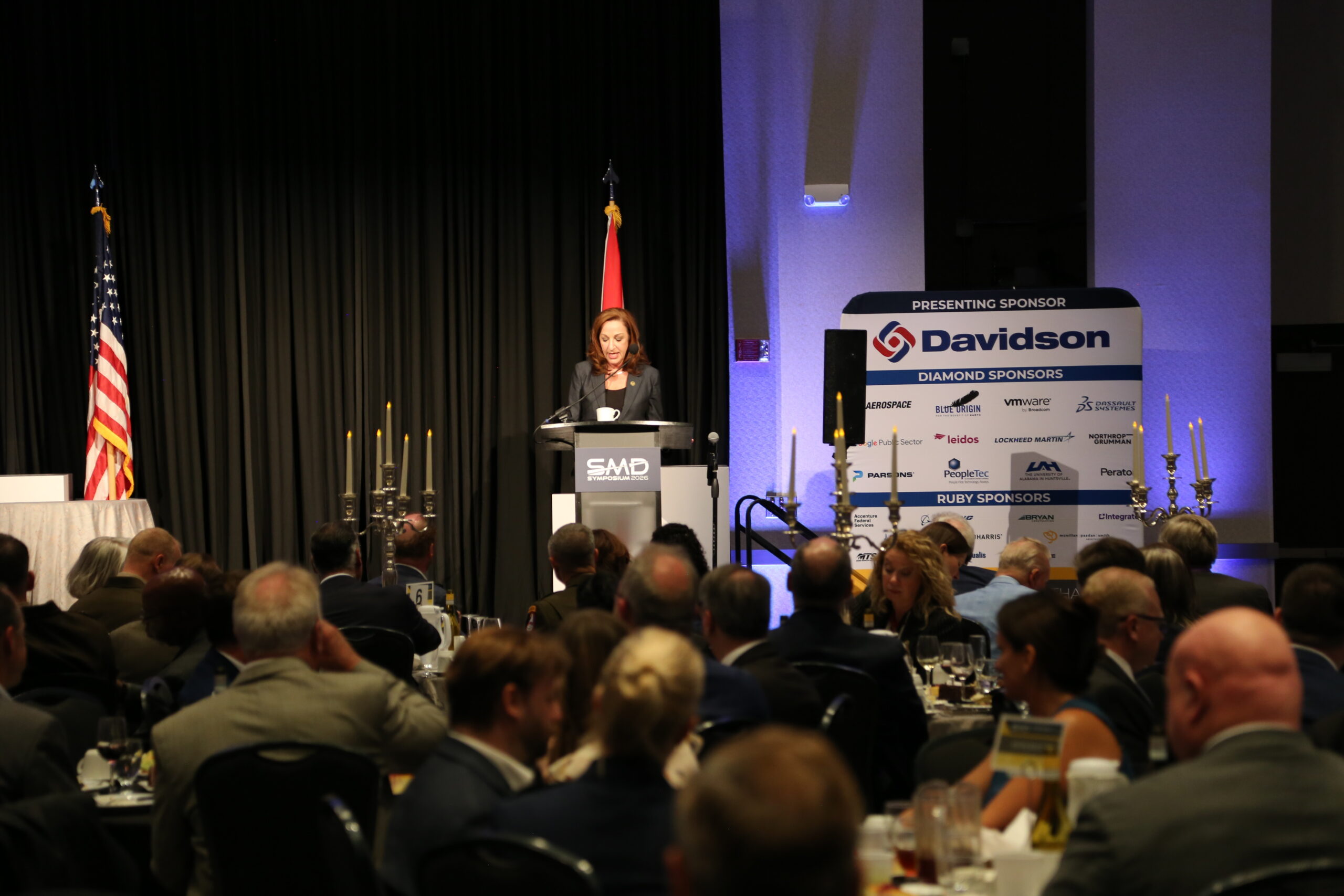
Speaking at the Dr. Julian Davidson Entrepreneurship Award dinner, the Golden Dome deputy director looked backward before looking ahead—tracing the evolution of U.S. homeland missile defense from work Davidson and his contemporaries pioneered through the changing architectures and threats that ultimately led to today’s Golden Dome mission.
“Huntsville is not just a location on a map,” Holmes told hundreds of defense professionals. “It is a crucible of human achievement. Our heritage of innovation has evolved into the shield that now protects our nation.”
That heritage was more than rhetorical framing. As the first director of the Advanced Ballistic Missile Defense Agency, Davidson championed technologies that helped make the Safeguard system possible—part of an engineering lineage Holmes used to frame what she described as another “critical inflection point” for homeland defense.
From Safeguard, Holmes moved through President Ronald Reagan’s Strategic Defense Initiative, the Ballistic Missile Defense Organization and the establishment of today’s Missile Defense Agency. Each evolved in response to a changing threat.
Golden Dome, she argued, must do the same. “Now is the time for a revolutionary leap forward.”
That’s amid an ever-present security threat bolstered by tools and tactics supercharged by powerful new technologies.
“The United States now faces unprecedented danger from rapidly advancing capabilities from peer and near-peer competitors,” said Holmes, whose examples of those capabilities included hypersonic glide vehicles, fractional orbital bombardment systems, and space-based weapons.
“The most consequential threat to our national resilience is a complex, multi-domain attack,” the defense veteran told the audience, painting a nightmarish picture of ballistic, hypersonic and advanced cruise missiles cutting through the sky, alongside unmanned aerial systems and space-based threats.
As a warning, the Department of War leader jointly responsible for modernizing the nation’s defense shield shared U.S. intelligence on a few countries the U.S. designates as foreign adversaries.
Holmes described a threat environment increasingly defined by simultaneous ballistic, hypersonic, cruise missile, unmanned and space-based threats—challenges that no longer fit neatly within the architectures developed for earlier eras.
“These combined dangers place the U.S. homeland at unacceptable risk. We have to be ready, and the time for just upgrading legacy systems has passed,” Holmes stated.
She urged defense contractors to meet this moment in three different ways:
Integrate what already exists
The former defense contractor wants industry to bring its current capabilities and technologies to the table. She said Golden Dome is already leveraging battle-proven systems, while focusing on both affordable and scalable capabilities.
“By improving, multiplying and seamlessly integrating the technologies we already have in our inventories today, we can build an incredibly robust defense right now,” she stated.
Break the cost curve
Holmes pointed out “a very hard mathematical truth” linked to military drones.
“If we attempt to defeat massive volleys of sophisticated, lower-cost weapons with multimillion-dollar interceptors, that is economically untenable for the long term. We cannot buy ourselves out of this problem,” she said.
To address the upside-down cost ratio, Holmes assured the audience Golden Dome leaders are aggressively investing in the latest pertinent technologies. “By expanding the number of threats that we can neutralize at a fraction of the cost, we guarantee that our defensive capacity can affordably outpace an adversary’s offensive volume.”
Change how technology enters the architecture
Holmes said Golden Dome’s “layered, disaggregated architecture” allows systems to operate independently, enabling faster upgrades and component replacements. She said the method also dramatically lowers costs. “It allows us to pull technologies in quicker, and it severely complicates the decision-making calculus of our adversaries.”
Holmes and her colleagues are looking to pull partners in speedily, too.
The Department of War is working to trade its historically slow acquisition processes for “strategies that emphasize speed, flexibility, accountability and the total revitalization of our defense industrial base,” said Holmes.
Just one day before her keynote address, the department launched a platform called “Golden Dome Hub” to make it easier for industry, academia, research labs, and venture capitalists to participate in the initiative, a DOW news release says.
“Our approach is designed to encourage multiple vendors, avoid vendor lock, reduce critical supply chain vulnerabilities, and enable production to scale seamlessly,” Holmes explained.