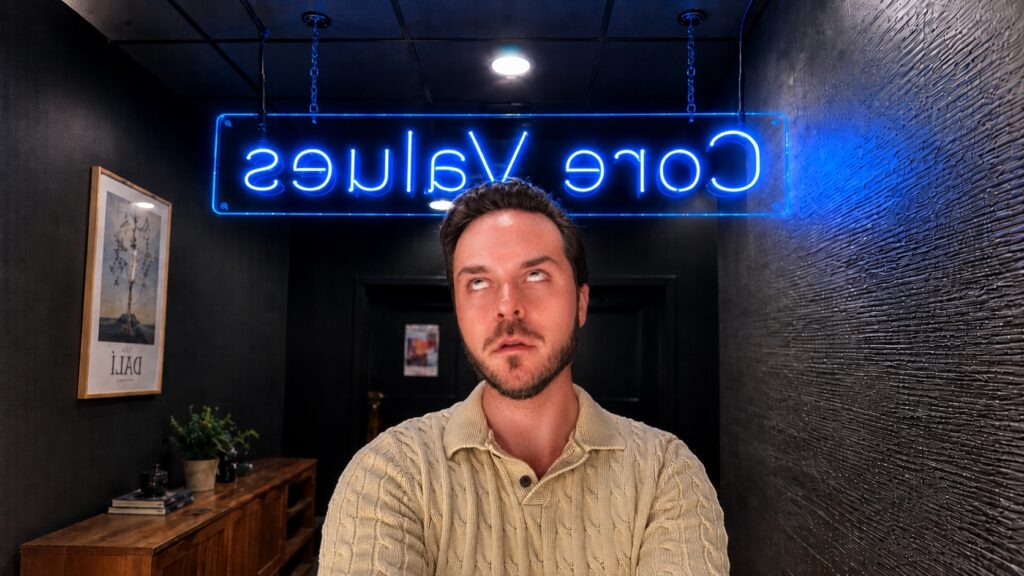
An open letter to my teammates and a case for taking guiding principles seriously, after corporate America gave everyone good reason not to.
By David Wood – Senior Director, Brand Strategy & Creative
Click below to listen to the audio version of this article, read by the author
Most people don’t need another corporate lecture about core values.
They’ve seen the live-love-laugh adjacent word art.
They’ve sat through the all-hands slides.
They’ve watched companies print words like integrity, excellence, accountability and respect on walls, mugs, lanyards and recruiting materials, only to see those same words disappear the moment they become inconvenient.
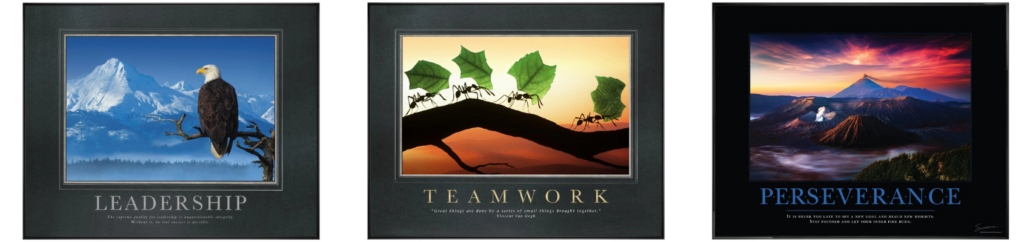
It’s the type of manufactured motivation that made every break room in America look like a leadership seminar at ski lodge via those acrylic-framed Successories posters…mountain peaks, rowing teams, bald eagles and one-word virtues trying to pass as culture.
The irony is that the “Ants Marching” reference might be more honest than the posters ever were. Corporate America has spent decades telling employees to march in formation beneath framed words like TEAMWORK and PERSEVERANCE, while too often giving them little reason to believe the words meant anything beyond compliance, endurance and a better attitude about the unabashed sameness.
As if culture could be downloaded and installed via a generic mountain photo hanging near the copy/print station and hoping people absorbed meaning through pictorial nothingness and fluorescent overheads.
So yes, when employees hear the phrase “core values,” an eye roll is understandable.
In some organizations, it’s been earned.
That’s the problem with values language. It’s been overused, overdesigned and underdelivered for decades. Too often, values become a promise made in public and broken in practice. And once that happens, skepticism isn’t cynicism. It’s pattern recognition.
At Davidson, we can’t afford for our values to become wallpaper.
Not because they sound good.
Not because they help with recruiting.
Not because they fit neatly into a brand campaign.
Because values are only useful if they help us decide how to act.
That’s the real test.
Our values weren’t crafted by the marketing team
There’s something important every Davidson employee should know about our core values.
They weren’t written in a marketing meeting.
They weren’t polished by a branding agency. They weren’t handed down by a small group of executives looking for words that sounded “sticky.” They weren’t created because someone wanted a cleaner slide or a sharper campaign.
A committee of 12 Davidson employees did the hard work.
They represented different regions of the country, different disciplines, different ages, different teams, different levels of seniority, different backgrounds and different lived experiences inside this company. They came into the room not as copywriters, but as employees who understand what Davidson looks like when it’s at its best.
Our small marketing and communications team of two wasn’t in the room.
We didn’t get to massage the language. We didn’t get to make it punchier. We didn’t get to harmonize or balance words because they more sounded better in a headline.
And honestly, that’s exactly why the values matter.
They came from the company. Not from the people responsible for promoting the company.
Our job now isn’t to sell them. Our job is to help socialize them, reinforce them and make sure they don’t get reduced to something employees see once a year and forget.
Because if our values are real, they shouldn’t need a campaign to survive.
They should show up in how we lead, how we work, how we communicate, how we disagree, how we solve problems and how we make decisions when the answer isn’t obvious or easy to swallow.
Values aren’t the words. Values are the pattern.
A company’s values aren’t proven by what it says when things are easy.
They’re proven by what it does when things become complicated.
When a program is under pressure.
When a customer needs an answer faster than expected.
When a teammate makes a mistake.
When a deadline gets uncomfortable.
When a leader has to choose between what’s easy to explain and what’s right to do.
When growth creates tension.
When change creates uncertainty.
When ownership becomes more than a concept.
That’s when values stop being language and start becoming culture.
In his PRSA article, “Why Culture Drives How Organizations Decide Under Pressure,” Jon Goldberg, founder and Chief Reputation Architect of Reputation Architects Inc., writes about the danger of values that are stated but never operationalized. His point is direct: organizations usually don’t struggle to name their values. They struggle to use them when the pressure is real.
That idea should land with us.
Because while Goldberg is writing through the lens of crisis communications and reputation management, the principle applies far beyond crisis response.
It applies to everyday company life.
Most culture erosion doesn’t happen in one dramatic moment. It happens in small, repeated decisions that quietly teach people what’s actually rewarded.
Do we reward the person who raises the hard question, or the person who keeps things quiet?
Do we celebrate speed only when it comes with discipline, or do we let urgency become an excuse for sloppiness?
Do we treat “People First” as a real leadership responsibility, or only as something we say when it’s time to talk about culture or order large quantities of pizza?
Do we expect “Mission Ownership” from everyone, or only from the people closest to the customer?
Do we define “Technical Excellence” as a standard, or let it become a phrase that sounds impressive but asks nothing of us?
Do we tout “Warfighter Always” because it’s obligatory patriotic language, or because it forces us to remember who ultimately depends on the quality of our work?
Values aren’t the words themselves.
Values are the pattern of behavior those words create.
The slope gets slippery fast
A promise made and not kept isn’t neutral.
It does damage.
When a company says it values people but burns them out without listening, employees notice.
When a company says it values innovation but punishes every thoughtful risk, employees notice.
When a company says it values ownership but centralizes every meaningful decision, employees notice.
When a company says it values excellence but tolerates preventable mediocrity, employees notice.
When a company says the warfighter is always the priority but lets internal friction slow down the work, employees notice.
That’s the slippery slope.
The first time values are contradicted, people may give the organization the benefit of the doubt. The second time, they may call it inconsistency. By the third or fourth time, they start believing the wall poster was the only tangible message all along.
That’s how culture becomes performative.
And performative culture is expensive.
It costs trust.
It costs speed.
It costs retention.
It costs credibility.
It costs the discretionary effort people only give when they believe the organization actually means what it says.
Davidson can’t build the next version of this company on performative values.
Especially not now.
Employee ownership raises the stakes
As Davidson moves closer to becoming an employee-owned company, this conversation becomes even more important.
Because ownership changes the frame.
You’re not just someone who works here.
You have a stake in this company’s success.
That doesn’t mean every employee suddenly carries the same responsibility as a senior officer. It doesn’t mean every decision becomes yours to make. It doesn’t mean ownership is a slogan we slap on top of the same old habits.
It means the connection between individual behavior and collective outcome becomes harder to ignore.
How we treat each other matters.
How we serve customers matters.
How we solve problems matters.
How we protect quality matters.
How we manage risk matters.
How we respond under pressure matters.
How we live the values matters.
Employee ownership isn’t just a financial structure. It’s a cultural responsibility.
If we want ownership to mean something, then the values have to mean something too.
Not as inspiration. As expectation.
Values should make decisions clearer
The best use of core values isn’t decoration.
It’s decision-making.
Goldberg makes the case that operationalized values act as guardrails when organizations have to make hard calls under pressure. He describes a crisis plan as a map, but values as a compass. That’s a useful distinction because maps help when the terrain is familiar. A compass matters when it isn’t.
At Davidson, our values should help us answer practical questions:
Does this decision put people first, or just say that it does?
Does this approach reflect purposeful innovation, or are we chasing novelty without mission impact?
Are we taking mission ownership, or waiting for someone else to solve what we already see?
Does this meet the standard of technical excellence, or are we hoping “good enough” will pass?
Does this keep the warfighter at the center, or have we let internal convenience become the priority?
These aren’t abstract questions.
They’re leadership questions.
They’re program questions.
They’re engineering questions.
They’re communications questions.
They’re business development questions.
They’re everyday employee questions.
And they belong to all of us.
Reputation isn’t only owned by marketing. Culture isn’t only owned by HR. Strategy isn’t only owned by executives.
Every decision teaches the organization what matters.
The goal isn’t perfect alignment. It’s honest practice.
We’re not going to get this right every day.
No company does.
There’ll be moments when we move too fast, communicate too little, overcomplicate something simple, avoid a hard conversation or miss an opportunity to lead with the values we claim to hold.
The point isn’t perfection.
The point is whether we’re willing to notice.
A real values culture doesn’t require everyone to recite five phrases on command. It requires people to understand what those values look like in practice and to recognize when our actions are drifting away from them.
That’s where the work is.
Not in launching the values.
Living them.
Not in announcing employee ownership.
In behaving like owners.
Not in telling employees to believe.
In giving them reasons to believe.
That distinction matters because belief can’t be mandated. It has to be earned repeatedly.
Employees believe values when they see leaders use them to make decisions.
They believe values when managers apply them consistently.
They believe values when peers hold each other to a standard without turning every disagreement into a impromptu and nonconsensual performance review.
They believe values when the company chooses the harder right over the easier wrong.
They believe values when the words survive contact with reality.
This is how we build the company we say we are
Core values have earned plenty of eye rolls.
But ours deserve better than that.
Not because the words are magic. Not because saying them more often will make them true. Not because a committee completed the assignment and now the rest of us are supposed to clap.
They deserve better because they were built by Davidson employees to describe the best of us.
They deserve better because they give us a shared language for the company we’re trying to become and sustain.
They deserve better because, as we move toward employee ownership, we need more than participation. We need shared responsibility.
That doesn’t happen through posters.
It happens through practice.
Our Values, in Practice
Our people are our greatest resource. As a future employee-owned organization, we invest deeply in our teams through top-tier benefits, continuous mentorship, and transparent communication. We foster a culture of accountability, integrity, and intellectual courage, empowering employees to take ownership of mission outcomes.
Combining intellectual courage with technical mastery, we apply novel technologies and deep domain expertise to build adaptable solutions that deliver immediate value and lasting mission impact.
We act with absolute accountability, treating the customer’s mission as our own. From challenge identification to final delivery, we operate with integrity and proactivity, doing whatever is needed to ensure timely, high-quality results and mission success.
We uphold high technical standards because the mission demands it. By combining elite talent with rigorous accuracy, we deliver solutions that are robust and scalable, ensuring our partners have the technical advantage.
The Warfighter is our driving force and our ultimate customer. Every decision, design, and line of code exists to protect and empower those on the front lines. We prioritize operational advantage above all else, delivering precise, ethical solutions that ensure decision superiority when it matters most.

Those aren’t marketing slogans.
They’re reminders.
They remind us how to lead when the decision is uncomfortable.
How to work when the pressure is real.
How to grow without losing the culture that made growth possible.
How to own the mission, live the values and share the outcome.
That’s the standard.
And if we mean what we say, it’s also the opportunity.

AUTHOR PERSPECTIVE
David Wood
Senior Director, Brand Strategy & Creative
David leads brand strategy, creative direction and marketing communications for Davidson. He helps shape how the company tells its story internally and externally, with a focus on clarity, culture, mission impact and the people behind the work.