By Rikki Klaus, Davidson Marketing & Communications Director

There are two types of mathematicians: the creative types and the problem solvers, Randall Gay, Ph.D. and Joe Ozbolt, Ph.D. decided in grad school at Auburn University.
“Me and Randy go way back,” said Ozbolt.

Best friends then and now, the colleagues at Davidson Technologies identify as creatives, in contrast to problem solver Patrick Gemperline, Ph.D., with whom they’ve worked since June.
“Creatives tend to daydream constantly about whacky mathematical ideas that oftentimes amount to nothing or become pet projects, but every now and then, a truly great idea comes up,” said Gay. “The more practically minded, like applied mathematicians and physicists (which Gemperline is), are more grounded in the reality of these ideas and are better suited to finding tangible results.”
To be fair, all three quantum computing engineers are great at both dreaming and doing. But when Ozbolt and Gay run budding ideas by Gemperline, they know there’s a chance their ideas could get turned down “in an authoritative but kind way,” Ozbolt said.
“Sometimes you have to get around your own sensitivities,” added Gay.
It’s this balance that allows the trio to press forward confidently and bravely, as they investigate the role of quantum computing in defense. This form of computing is an emerging technology, but even more so in this field, where its application is largely unrealized.
One of the only quantum computers in the world intended for high-stakes defense use cases is housed at the scientists’ Huntsville, Alabama office: the D-Wave Advantage2™ system.
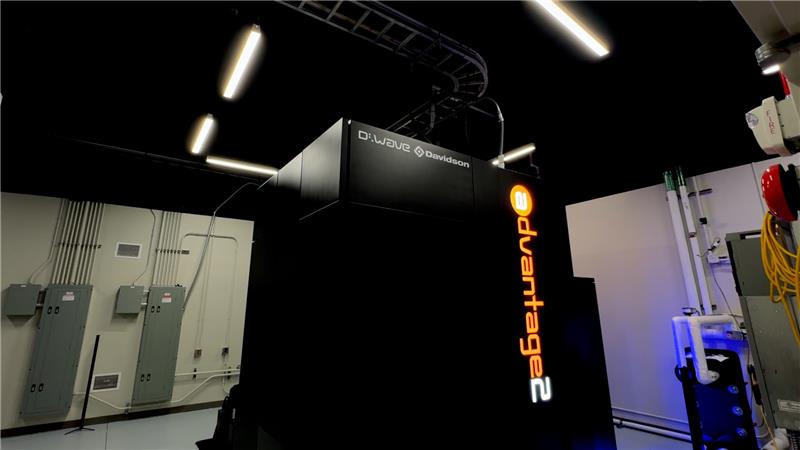
Gemperline, Gay and Ozbolt meet almost daily to discuss code they’ve been developing and to bounce ideas off each other, as they work to understand how quantum physics, harnessed in computer form, can support more optimal and expedient decision-making for the military.
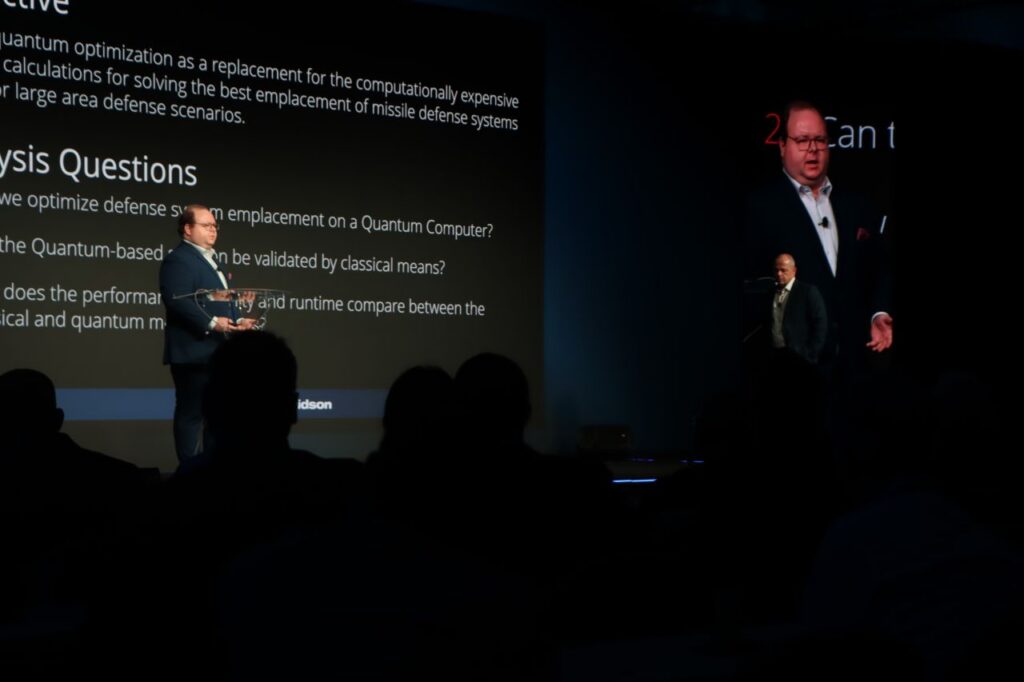
The team is building off a recent successful study Gemperline conducted with fellow defense technology company Anduril Industries and quantum computing company D-Wave that demonstrated quantum superiority over classical computing in missile emplacement. Forbes reported, “this is an exceedingly hard computational problem.”

The engineers recently visited NASA‘s Marshall Space Flight Center, alongside three Davidson colleagues, to explore how they could support NASA’s moon mission.
“We got to see a lot of cool things and were able to brainstorm,” said Gay. “I could definitely see quantum utility there.”
When not touring or meeting, they’re coding in Python, troubleshooting and debugging code, and testing different approaches to solve real-world problems.
“Quantum computing has the potential to transform a wide range of military and defense applications,” said Ozbolt.
Ozbolt, Gay and Gemperline genuinely love learning and are passionate about their field. They all went to Auburn University and have degrees in mathematics. They’re all really darn smart.
But beyond that, their backgrounds and interests are unique. Allow us to introduce you to Davidson’s quantum computing engineers.
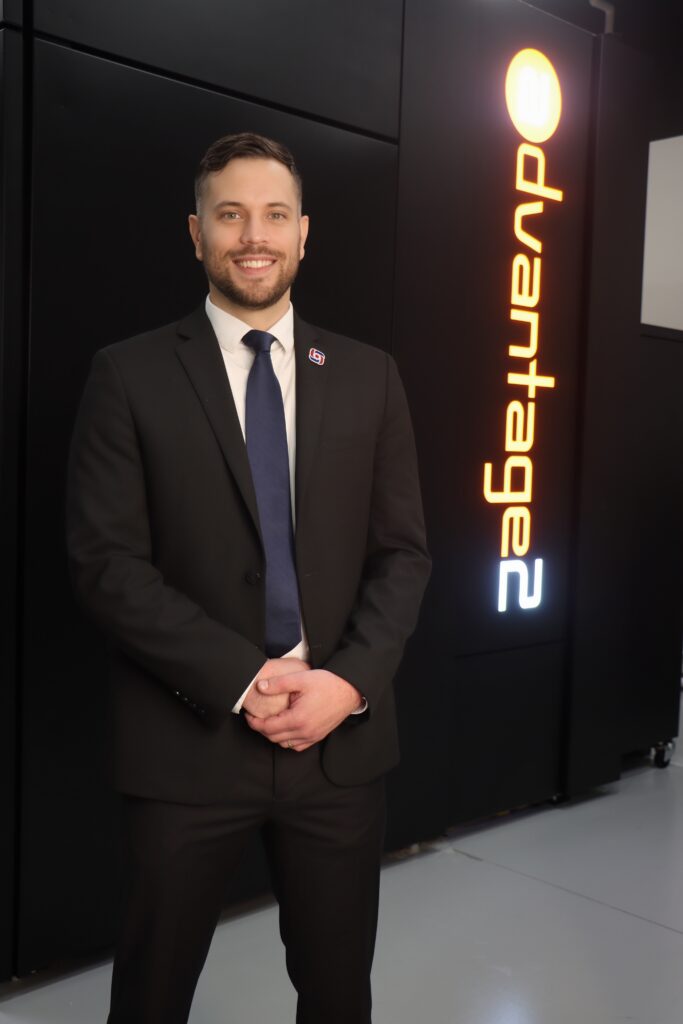
Photo credit: David Wood
The Heavy Metal Fan | Joe Ozbolt, Ph.D.
Joe Ozbolt, Ph.D. was one of nine children in his Northeast Ohio home. Four baby girls preceded him, and his mother was ready for a change.
“She prayed during Eucharistic Adoration asking God for one more boy, closing her prayer with, ‘And if you give me two more boys, that would be okay too.’”
Her prayer was answered. Joe was born first, then his little brother.

Ozbolt said their life was chaotic and fun, and there was always someone to hang out with.
He earned bachelor’s degrees in physics and mathematics at the University of Toledo, then his master’s and Ph.D. in mathematics at Auburn University. He interned at NASA.
“Two days before classes started in my first year at Auburn, I met my beautiful wife,” Ozbolt recounted. They married in grad school and are now parents of young children.
Outside of work, Ozbolt spends most of his time with his family, listens “to a lot of heavy metal,” reads nonfiction, and hikes.
He described working in quantum computing at Davidson as “the best opportunity I could have imagined.”
“I can’t stress enough how grateful I am to have become part of Davidson. It truly is a privilege not just because of the engaging work I get to do, but also because the people and the culture are top-notch,” said Ozbolt.
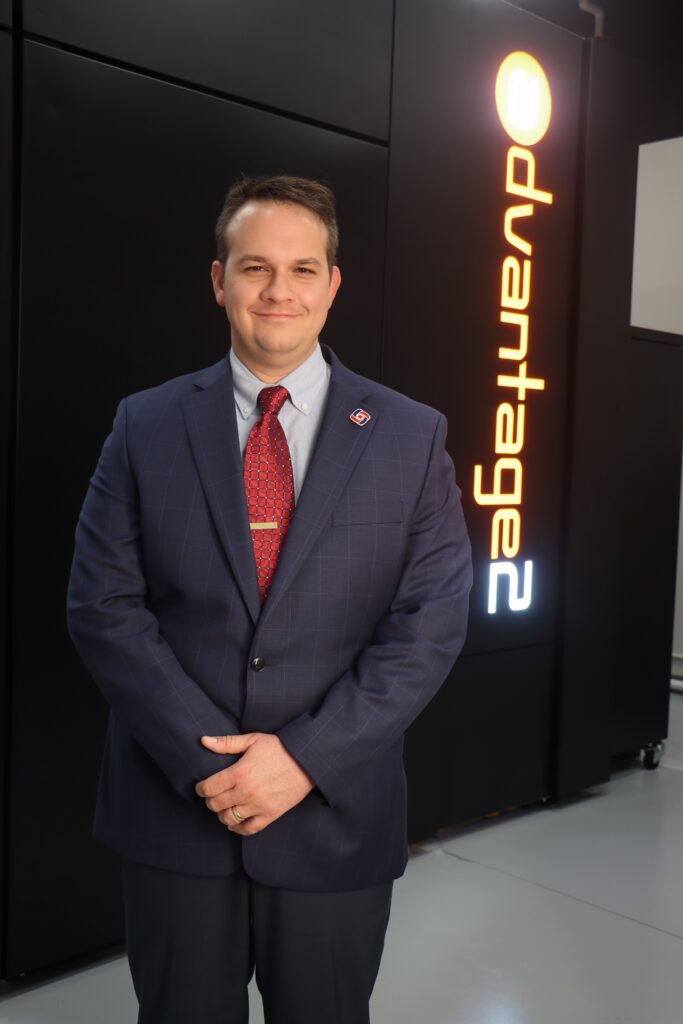
Photo credit: David Wood
The Catholic Apologist | Randall Gay, Ph.D.
Randall Gay, Ph.D. has done what very few, if any, quantum computing engineers have done before: raise twins.
Now one-year-olds, the boys are learning fast from their older sister, all while keeping their parents very busy.
When asked about hobbies, Gay responds with another question: “When do you have the time?” He identifies as “kind of boring actually.”
The engineer from Dothan, Alabama joined the Navy after getting his master’s degree in 2015 at Auburn University. Meanwhile, he did “little math pet projects at home in the evenings.” While working at the Naval Nuclear Power Training Command, he could not shake a goal: “I told my wife, I have to get my Ph.D. It’s going to drive me nuts, if I don’t.”

During the program, quantum algorithms fascinated him. “This feels like magic almost, but the math checks out,” he said.
Randy’s passions now swing from science to spirituality.
“My biggest hobby at this point is learning and reading about Catholicism,” the “former atheist agnostic” said. “There are too many weird things at play here that I cannot explain, and it was the same leap of faith in either direction of either belief or non-belief, and I’m like, well, I’m going to opt for hope here.”
Another hope of his is to combine the things that awe him.
“I have this dream of wanting to apply actual, formal logic to arguments for theological arguments,” he said.
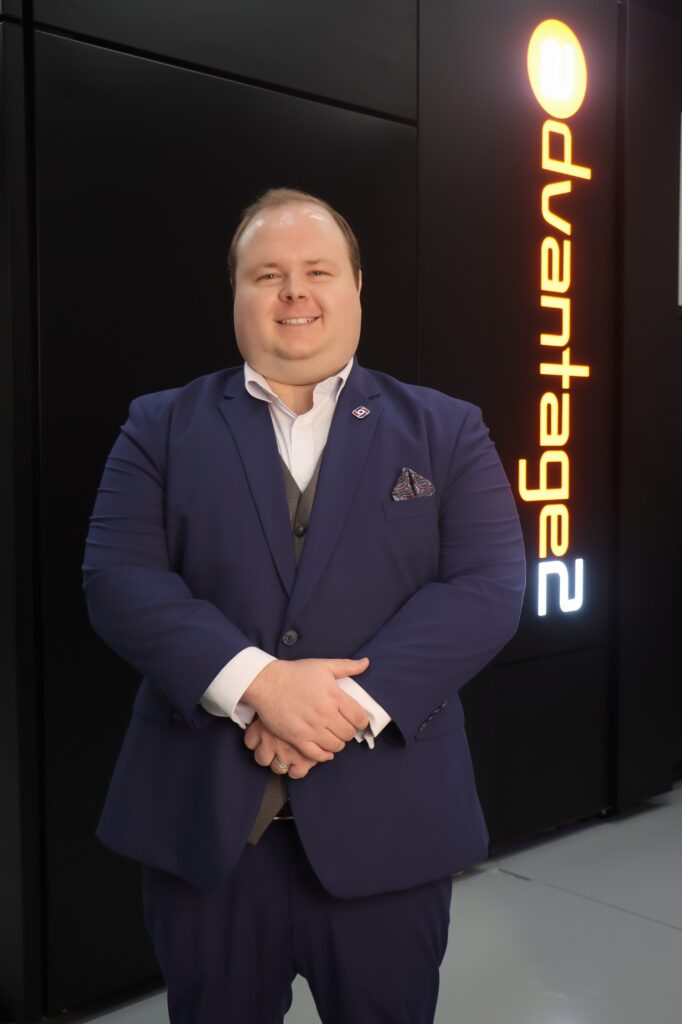
Photo credit: David Wood
The Magic: The Gathering Judge | Patrick Gemperline, Ph.D.:
Patrick Gemperline, Ph.D. was born in Louisville, Kentucky. His father delivered FedEx packages, and his mother served as an audiologist at the VA. Gemperline attended Catholic school all the way through college at Xavier University. He met his future wife in a physics class. They married last September at his childhood church. Like his fellow engineers, Gemperline got his Ph.D. from Auburn University.

“During undergrad and graduate school, I got to work at some interesting places like a USDA field lab and Oak Ridge National Laboratory,” he said.
Gemperline is an avid fan of board and card games — “the more complex the better.”
“Magic: The Gathering is a personal favorite. It has a 200+ rule book and is complex enough to need people like me who are trained as judges to mediate rule disputes,” said Gemperline.
He also likes trivia, helping his team earn the top spot at Davidson’s 2025 holiday party.
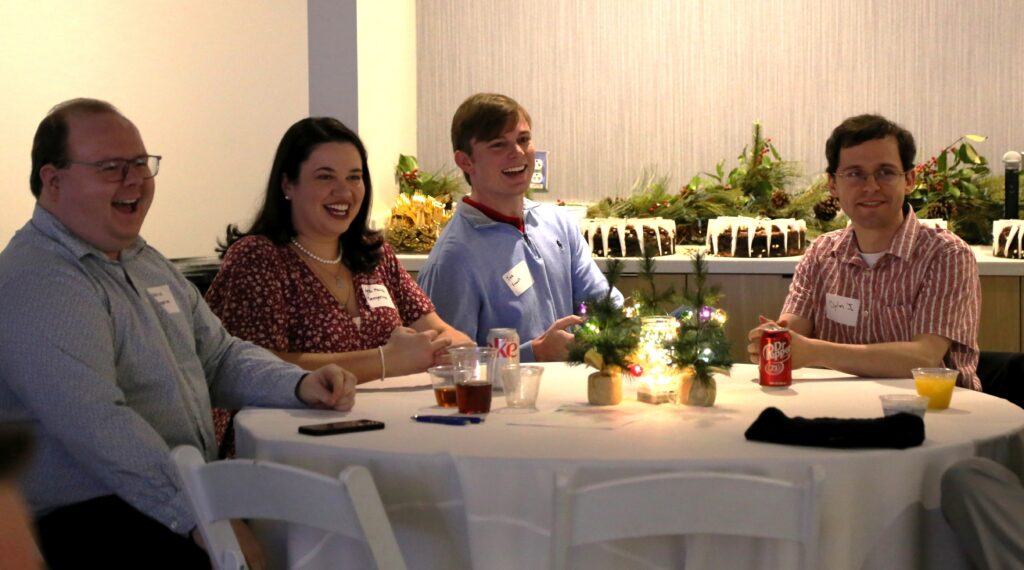
The most misunderstood thing about quantum computing, Patrick says, is “people often think that in the future everything is quantum. In certain calculations and problems, we get massive speedups and improvements, but for everyday things like looking at memes online, we will keep using classical computing.”
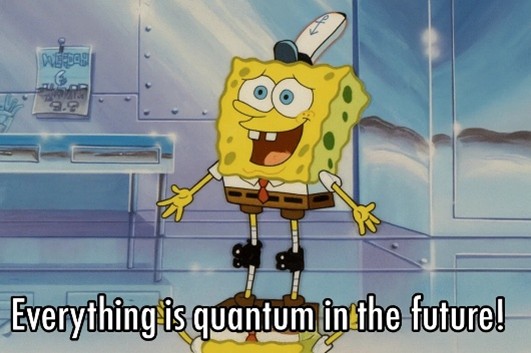
Gemperline and his colleagues look forward to a time when quantum computing becomes a universal game changer in the defense industry, making families like theirs safer.
Until then, Ozbolt says they’ll continue their leading-edge work, doing tasks like “searching for maximal matchings of multiple bipartite graphs, formulated as a quadratic unconstrained binary optimization problem.”