By Rikki Klaus, Davidson Marketing & Communications Director
“There are a lot of odd and mysterious phenomena in quantum mechanics,” says Joe Ozbolt, Ph.D., quantum computing engineer at Davidson Technologies.
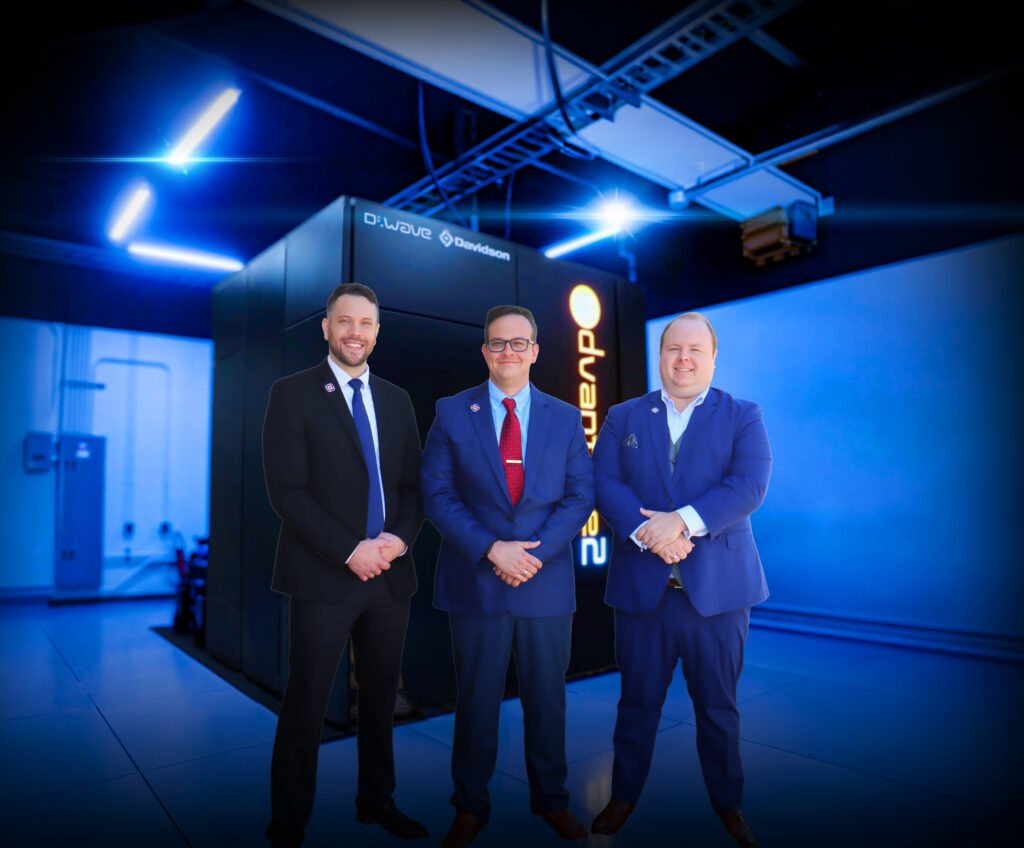
In Huntsville, Alabama, Ozbolt and his colleagues, Randall Gay, Ph.D. and Patrick T. Gemperline, Ph.D., use a supercharged coupling of quantum and classical computing to develop solutions to national security challenges.
I asked the trio, who completed doctorates in physics and mathematics, for a rundown of quantum’s most curious behaviors. I summarized and simplified their responses below for the non-expert, like me.
Quantum physics, explained
Quantum physics is the study of energy and matter.
It looks at how atoms and subatomic particles interact, says NASA, examining “the very stuff we, and everything around us, are made of.”
“Quantum mechanics is one of the two great pillars of modern physics, along with Einstein’s theory of general relativity, that models the fundamental nature of our physical universe,” Ozbolt says.
Quantum mechanics is crucial to the inner workings of the internet, smartphones, and MRI machines.
Quantum’s perplexing properties
Quantum algorithms feel “like magic almost, but the math checks out,” says Gay.
All three scientists are quick to point out that quantum mechanics remains one of the most complex and counterintuitive domains in modern science. Much of it still challenges even the experts.
“An exact philosophical or ontological understanding of quantum mechanics has evaded researchers for over a century,” says Ozbolt.
“Quantum mechanics is one of the most researched and experimented subfields of physics, but it continues to befuddle anyone who touches it,” says Gay. “Even the world-renowned physicist Richard Feynman, who pioneered many topics within quantum mechanics and worked on the Manhattan Project, once said in a 1964 Cornell University lecture, ‘I think I can safely say that nobody understands quantum mechanics.’”
Quantum eschews classical intuition.
“Your experience with things that you have seen before is inadequate, is incomplete,” Feynman told the audience. “The behavior of things on a very tiny scale is simply different. It behaves like nothing that you’ve seen before.”
Ozbolt clarifies that Feynman’s statements do not apply to the math associated with quantum theory or its predictive capabilities.
“The mathematical formalism that defines and describes quantum phenomena is extremely well understood. It provides extraordinary predictive accuracy,” Ozbolt says. “Feynman’s comments reflect the absence of a universally accepted account of what the theory says about the underlying nature of reality.”
A shocking experiment
The double-slit experiment, which demonstrates light in both particle and wave forms, is foundational to the field of quantum physics.
British scholar Thomas Young wanted to settle a debate between two competing theories on the nature of light: Isaac Newton’s assertion that light was made up of particles – and Christiaan Huygens’ belief that it was made up of waves.
In 1801, Young shined light through a narrow slit in a barrier, then two slits behind that. The first slit produced alternating bright and dark bands, like ripples in a pond. When the light traveled through the remaining slits, the ripples overlapped, which is called interference. A screen captured the pattern, confirming wave-like behavior.
Following in Young’s footsteps in the last 225 years, a number of scientists have run their own versions of the experiment. When they’ve shot just one photon or electron at a time through slits, the particle amazingly appears to interfere with itself, as if passing through both slits at the same time.
Just as mindboggling, an observer actually changes the outcome. When researchers measure the particle’s movement, the interference pattern vanishes, and the particle chooses a definite position, sailing through just one slit.
“It seemed as though observing which choice the electron was making affected the outcome,” says Ozbolt. He called the initial reactions to the findings “shocking.”
Supernatural superposition
Superposition is the phenomenon where particles simultaneously hold more than one value at the same time.
“They’re in this mix of different states. Electrons can be spinning ‘clockwise’ or ‘counterclockwise’ at the same time,” Ozbolt explains.
“It’s like a coin spinning in the air, neither heads nor tails until it lands,” writes the Medium contributor Algomehr.
Once observed, however, the particle chooses a state.
“Things aren’t as definite as we’re used to seeing,” analyzes Ozbolt. “This inherent uncertainty, described by probabilities, is fundamental to quantum mechanics.”
Spooky science: Quantum entanglement
Albert Einstein once described quantum entanglement as “spooky action at a distance.”
Despite exisiting on opposite ends of the observable universe, two entangled particles can mirror each other.
“The minute one is observed, the other one immediately assumes the value in correlation,” Ozbolt says.
Entangled states, which do not permit faster-than-light signaling, defy classical intuitions about separability and locality, says Ozbolt.
“It is this departure from classical realism that leaves us wondering what kind of underlying structure reality must have to permit such correlations,” he says.
Violating Intuition: Quantum Tunneling
To describe quantum tunneling, Ozbolt paints a scene: A person walks up to a high wall they can’t climb. It’s too tall, and there’s no foothold. So, the person simply stops.
Not so with particles, which can tunnel through a barrier, even when they don’t have enough energy to do so.
“It definitely violates one’s intuition, but it’s not violating any physical law there. Unlikely things happen sometimes,” says Ozbolt.
“Amazing” technologies
“The most interesting thing about quantum mechanics is how unintuitive it is,” says Gemperline, “and that despite that, we have created amazing technologies that take advantage of it.” Technologies like quantum computers, which Davidson and Anduril Industries recently leveraged in a new defense study on quantum emplacement for air and missile defense systems, with the goal of making the world a safer place.
To learn more about the cutting-edge and ever-evolving quantum computing work of Ozbolt, Gemperline and Gay, follow them here:
Joe S. Ozbolt, Ph.D. | LinkedIn,